Bridge the Gap: Aligning University Assessments with Australian Corporate Standards
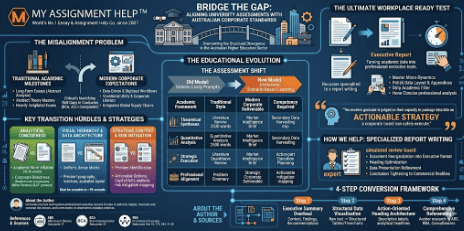
The contemporary Australian higher education sector is undergoing a profound structural transition. For decades, the primary benchmark of academic success was the mastery of abstract theory, demonstrated through traditional long-form essays and heavily invigilated end-of-semester examinations. However, as the Australian domestic marketplace becomes increasingly digitised, data-driven, and highly integrated with global supply chains, a significant structural divergence has emerged between conventional academic milestones and real-world corporate expectations. Australian employers across Sydney, Melbourne, Brisbane, and Perth are now demanding a workforce that possesses immediate vocational utility, corporate literacy, and practical analytical capabilities from day one.
This structural misalignment has profound economic and practical implications for domestic and international students alike. According to recent longitudinal employment data, corporate talent acquisition managers are increasingly identifying critical skills gaps in graduate hires, particularly regarding operational project management, compliance evaluation, and data synthesis. When undergraduate or postgraduate students confront these highly technical corporate expectations without sufficient preparation, their academic progress and career trajectories suffer. Navigating this demanding landscape often requires targeted operational support, which is why consulting with comprehensive digital portals has become an essential strategy for ambitious scholars. Securing reliable, localized assignment help in Australia enables young professionals to workshop their concepts against practical grading criteria, ensuring their terminal submissions closely mirror the rigorous compliance and execution frameworks used across premier domestic institutions.
To fully understand this educational evolution, one must analyze the shifting composition of university assessment rubrics. Australian universities are systematically moving away from hypothetical essay prompts to integrate immersive, scenario-based learning models. This pedagogical change is intentionally designed to address long-standing complaints from industry groups such as the Business Council of Australia (BCA) and the Australian Chamber of Commerce and Industry (ACCI). Modern unit coordinators are tasked with engineering assessment tasks that evaluate not merely what a student knows, but how effectively that knowledge can be translated into commercial or institutional value. Consequently, assessments are shifting toward strategic business cases, data-driven financial audits, technical laboratory portfolios, and client-facing executive briefs.
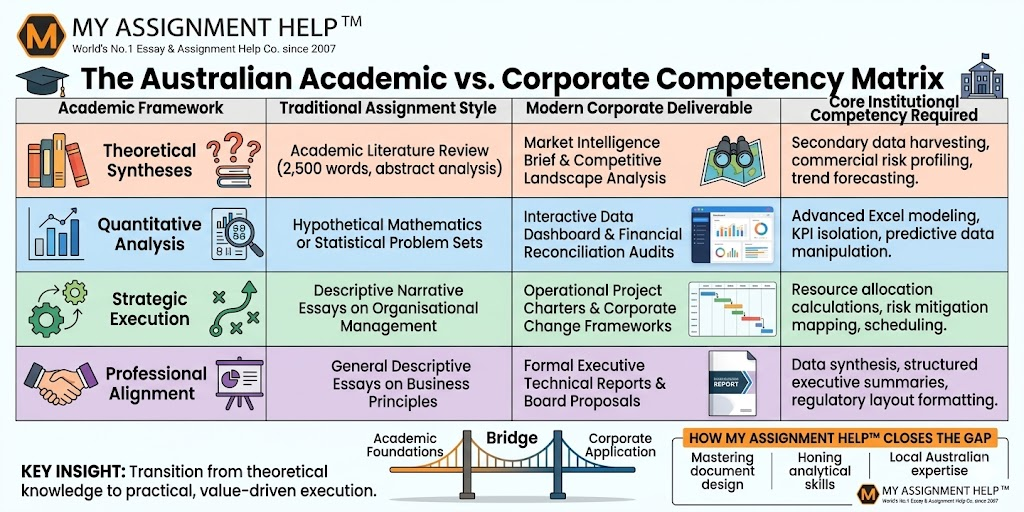
The ultimate test of an undergraduate student’s readiness for the Australian corporate workforce occurs when they are required to compile, format, and present complex operational data to institutional stakeholders. Within sectors like consulting, engineering, public health, and banking, the most critical document a professional will ever produce is an executive text. Turning to a premium Report Writing Service from a highly credentialed, specialized provider allows students to master the micro-dynamics of data layout, industry-standard appendices, and concise professional analysis. Learning how to strip away academic filler and present a polished executive summary is a foundational skill that bridges the gap between university grades and corporate onboarding success.
The Evolution of Australian Assessment Architecture
The traditional structure of higher education in Australia historically favoured the “ivory tower” model of learning—valuing intellectual exploration above immediate commercial application. While this paradigm successfully nurtured critical thinking, it left a visible vacuum in operational readiness. In the current economic climate, marked by rising operational overheads and tight corporate budgets, firms can no longer afford the extensive six-to-twelve-month onboarding pipelines that were common a decade ago. Australian enterprises now recruit based on “plug-and-play” capabilities, expecting graduates to possess an immediate command of enterprise workflows.
To meet this economic demand, academic institutions nationwide have undertaken a major overhauling of their syllabus designs. Assessment items are now intentionally mapped to professional frameworks. For example, instead of a standard accounting essay regarding historical fiscal policies, a student at an Australian university is now required to audit a live, de-identified corporate balance sheet, identify tax compliance variances, and present their findings in a format that mirrors an Australian Taxation Office (ATO) submission. Similarly, engineering and environmental science scholars are frequently evaluated on their ability to produce comprehensive environmental impact statements that comply directly with state-level environmental protection legislation.
This structural alignment serves a dual purpose. It forces the student to develop deep, field-specific technical capabilities while simultaneously exposing them to the strict operational constraints of real-world industries, such as strict page limits, mandatory executive summaries, data visualization requirements, and rigorous professional ethics. It shifts the primary educational objective from the simple retention of facts to the execution of complex data manipulation under realistic industry pressures.
“The modern graduate is no longer judged solely by their ability to recall legal statutes or financial equations. They are judged on their capacity to package that data into an actionable strategy that a corporate board of directors can safely execute without further refinement.”
1. Analytical Conciseness vs. Academic Word Inflation
One of the most profound hurdles an undergraduate faces when transitioning to a corporate mindset is the management of word budgets. In an academic setting, students are frequently given substantial word counts (e.g., 3,000 to 5,000 words) and are implicitly incentivised to expand on concepts, historical context, and theoretical nuances to prove they have completed the required reading. This often results in a dense, highly descriptive prose style.
Conversely, the corporate environment treats word inflation as an operational inefficiency. A corporate executive or managing director does not have the luxury of reading a thirty-page document to uncover a single operational recommendation. Corporate writing demands a direct, concise style where the most critical insights—the bottom-line conclusions—are placed at the very beginning of the document. This approach, often referred to as the Minto Pyramid Principle or Bottom-Line Up-Front (BLUF) protocol, requires a radical restructuring of a student’s cognitive framework, shifting the focus from data narrative to data synthesis.
2. Visual Hierarchy and Data Architecture
Academic papers are traditionally uniform in appearance, consisting of consistent blocks of text, standard serif typography, and minimal visual differentiation beyond basic section headings. This formatting style is designed to facilitate blind peer reviews and standardized grading. However, this monochrome presentation layout fails completely within a fast-paced corporate boardroom.
A professional corporate brief relies heavily on an intuitive, highly accessible visual hierarchy. This infrastructure utilizes precise, bold typography, clear callout text boxes for key data metrics, integrated matrices, and custom data visualizations (such as Gantt charts, risk heatmaps, and financial waterfall diagrams). If a strategic report cannot be scanned and understood within ninety seconds by a senior stakeholder, it fails to achieve its functional objective, regardless of how accurate the underlying data may be.
See also: How Blockchain Technology Supports Secure Transactions
3. Strategic Context and Risk Mitigation Mappings
In a university environment, a student can easily secure a passing or high distinction mark by identifying a problem and analyzing its root causes from an academic standpoint. The focus is primarily on diagnostic accuracy. However, in the corporate world, diagnosis is merely the introductory step; the true value lies in execution and risk management.
Every corporate deliverable must present clear, actionable options alongside structured risk mitigation maps. If an analyst recommends that a logistics enterprise invest in automated warehousing technology, they must also provide an exhaustive analysis of the capital expenditure (CapEx) requirements, projected operational expenditure (OpEx) reductions, a detailed deployment timeline, and an evaluation of workforce disruption risks. Academic writing frequently treats these practical variables as secondary concerns, whereas corporate standards position them as the core pillars of strategic decision-making.
The Essential Role of Specialized Report Writing Service Portals
Given the sharp learning curves associated with these professional standards, it becomes clear why generic academic templates are no longer sufficient for students aiming for top marks. Mastering professional document design requires specialized guidance that mirrors corporate training environments. This operational gap explains the increasing demand for an expert, dedicated report writing service among contemporary scholars across the country.
A professional report writing service does not merely check for basic grammatical accuracy; it serves as a practical, simulated corporate review board. When a student utilizes these professional resources, their draft papers undergo an extensive editing process that refines the entire structure of the document. The text is reorganized into an executive format, ensuring that headings are action-oriented, data is presented in clear visual tables, and conclusions are tightly tied to commercial realities. This process provides students with a high-quality template that teaches them how to present data clearly and effectively in their future careers.
Key Takeaways for Australian University Students
- Embrace the BLUF Protocol: Always place your primary conclusions, financial bottom lines, or strategic recommendations at the beginning of your documents. Never bury your core insights under layers of historical context.
- Master Professional Layouts: Transition away from monolithic blocks of text. Ensure your reports leverage bold, descriptive subheadings, bulleted data points, and custom infographics to maximize scanning efficiency.
- Quantify Your Arguments: Replace ambiguous qualifiers such as “substantial growth” or “significant drop” with precise, empirical metrics, clear percentages, and specific financial figures wherever possible.
- Focus on Risk Mitigation: Never present a corporate problem without also detailing a realistic, costed roadmap to mitigate the associated operational or regulatory risks.
A Guide to Transforming Academic Documents into Corporate Reports
For students eager to immediately realign their university work with professional expectations, the following four-step conversion framework can be applied to any standard business, technology, or healthcare assessment task:
Step 1: The Executive Summary Overhaul
Remove the traditional, vague introductory paragraph that merely restates the assessment prompt. In its place, construct a precise, one-page Executive Summary. This section must be structured using three explicit subheadings: Context/Objective, Core Findings/Data Synthesis, and Strategic Recommendations. This ensures that a senior stakeholder can grasp the entire scope of the document without turning a single page.
Step 2: Structural Data Visualisation
Review every paragraph within your draft that contains dense statistical listings, comparative parameters, or chronological timelines. Take that raw text and convert it into a structured, bordered table or an illustrative flowchart. If you are describing a supply chain delay, map it visually using a process diagram. Visual communication increases reader retention and demonstrates a high level of professional data literacy.
Step 3: Action-Oriented Heading Architecture
Replace generic, uninspired headings like “Introduction,” “Body Paragraph One,” and “Conclusion” with active, informative labels. For example, instead of writing “Section 4: Financial Overview,” use an analytical heading such as “Section 4: Supply Chain Automation Expected to Reduce Annual Operational Expenditure by 14%.” This strategy ensures that the document’s core narrative remains clear, even when a reader is simply skimming the headings.
Step 4: Comprehensive Referencing and Fact Verification
In the corporate world, an unverified assertion can result in severe legal liability or significant financial loss. Therefore, every market claim, growth projection, or regulatory statement made within your report must be backed by a highly reliable, authoritative source. In an Australian context, this means anchoring your research in official data from institutions like the Australian Bureau of Statistics (ABS), major industry updates from the Reserve Bank of Australia (RBA), or formal sector overviews published by leading global management consultancies.
Frequently Asked Questions (FAQ)
1. Why are Australian universities shifting away from traditional essays?
Traditional essays evaluate abstract theoretical retention but often fail to build or test functional workplace skills. Universities are restructuring their assessment programs to match corporate expectations, ensuring that graduates can immediately deliver value in fast-paced corporate environments.
2. What is the “Bottom-Line Up-Front” (BLUF) writing protocol?
BLUF is a professional communication framework where the primary conclusion, recommendation, or analytical takeaway is presented clearly in the opening sentence or paragraph of a document. This allows busy executives to grasp key insights instantly without navigating through dense historical text.
3. How do professional report writing services assist in career readiness?
A specialized report writing service acts as an external review board, helping students restructure academic drafts into polished, board-ready executive documents. This process teaches students how to apply proper visual hierarchies, format complex appendices, and maintain an objective corporate tone.
4. Should I include data visualisations in all my business reports?
Yes. Integrating data architecture—such as structured tables, risk heatmaps, and financial metrics—dramatically improves the usability and professionalism of a document. It breaks up dense text blocks and allows readers to scan and interpret complex data points within seconds.
About the Author
Kara Betty is a Senior Content Strategist and Higher Education Analyst specializing in the alignment of Australasian university curriculums with modern workplace standards. With over a decade of experience in corporate document design and academic compliance consulting, they help students navigate complex professional assessment systems and transform theoretical studies into practical, career-ready portfolios.
References & Empirical Data Sources
- Australian Bureau of Statistics (ABS). (2025). Characteristics of Recent Graduates and Workforce Competency Variances. Commonwealth of Australia.
- Business Council of Australia (BCA). (2024). Future-Proofing the Nation: Aligning Higher Education Outputs with Enterprise Demands. BCA Institutional Reports.
- Reserve Bank of Australia (RBA). (2025). Digital Transformation and Structural Labour Market Productivity Across Domestic Service Sectors. RBA Economic Papers.