The Peptide That Didn’t Move the Average, and the Market That Didn’t Either

Picture someone in early 2026 doing the thing they’ve done for two years running: pulling up an old bookmark, a research-chemical site that used to ship a vial of epithalon within three days, no questions, no ID, no doctor in sight. The page loads slow. Then it doesn’t load at all. Somewhere between one order and the next, the federal crackdown on the peptide gray market caught up with the site, or the site got nervous and quietly stopped answering emails. Multiply that moment by a few thousand buyers, and you have the actual texture of what changed in 2026. Not a ban on a molecule. A thinning of a crowd.
Here’s what nobody selling epithalon wants to lead with: the science underneath the hype didn’t change one bit when the market did. It was thin and oddly concentrated before the crackdown, and it’s thin and oddly concentrated now. What the enforcement wave actually exposed wasn’t a compound’s safety profile. It was the accountability question buyers should have been asking from the start, dressed up as a supply question.
What the crackdown actually did
For years, getting epithalon meant a search, a chemical-supply storefront, and a vial in a padded envelope stamped “for research use only, not for human consumption.” That label wasn’t fine print. Read plainly, it’s a legal disclaimer that the product in your hand was never sold to you as something to inject. Nobody checked that promise against the contents, and nobody was on the hook if the two didn’t match.
The 2026 enforcement effort leaned on exactly that model, the sell-to-anyone vendors with no clinician anywhere near the transaction. A number of the familiar names went dark or got cagey about what they’d ship. If a bookmark of yours stopped answering, that’s why.
But notice what stayed exactly the same size: the pile of published evidence. It didn’t grow. It didn’t shrink. The crackdown just stripped away the comfort of a habit and left the actual question sitting there, unavoidable. Who was ever accountable for what was in that vial? The honest answer, both before 2026 and after, is close to nobody.
The pitch you’ve already half-absorbed
The marketing version goes something like this: a tiny four-piece peptide flips a dormant enzyme called telomerase back on, stretches the protective caps on your chromosomes, and resets a clock your own cells were never supposed to be able to touch. Some sellers attach hard lifespan numbers to that story. It’s a tidy pitch. It name-drops Nobel-adjacent biology and speaks directly to anyone who already believes aging is a dial, not a fact of being alive.
Worth saying plainly: a tidy pitch is not the same thing as a settled one. Most of the pages selling this peptide open with the mechanism story and tuck the caveats somewhere near the shipping policy. Flip that order, and the picture looks different.
What actually happens is real, in a dish
Start with what holds up, because dismissing all of it would be its own kind of dishonesty. In 2003, Vladimir Khavinson’s group added epithalon to cultures of telomerase-negative human fetal fibroblasts and watched telomerase switch on, activity rise, and telomeres lengthen (PMID 12937682). That’s a real, specific result in human cells, and it’s the engine behind every headline claiming the peptide “lengthens your telomeres.”
For two decades that finding stood alone, which should have bothered more people than it did. Then in 2025, a group at Brunel University London with no connection to Khavinson’s lab reported the same broad effect: epitalon increased telomere length in human cell lines, through telomerase in normal cells and through a separate pathway called alternative lengthening in cancer cells (PMID 40908429). Independent replication of a mechanism is the kind of thing a careful reader should take seriously. So take it seriously.
Just hold the other half of that sentence too. These are cells in plastic dishes, not people. A peptide lengthening telomeres in vitro is a fact about a culture, not a demonstration that anyone who injects it ages slower or lives longer. And that 2025 paper drew its own line between the normal-cell pathway and the cancer-cell pathway, a small detail that quietly undercuts the idea that “more telomere lengthening” is simply good news wherever it happens.
See also: The 10 BPC-157 Sources I’d Actually Use in 2026 (and Why Most People Shop This Wrong)
Where the story actually lives: the tail, not the average
Here’s the detail that gets rounded off or skipped entirely, and it’s the one worth sitting with, because it reframes the whole animal record.
In fruit flies, Khavinson’s group found that epitalon given during development raised lifespan by 11 to 16 percent (PMID 11087911). Real, but flies.
The mouse study is the one that should slow every reader down. In female SHR mice, epitalon did not change the average lifespan of the group at all. What moved was the tail end of the distribution: the last 10 percent of mice still alive lived longer, maximum lifespan rose by 12.3 percent, leukemia dropped, and total tumor rates stayed flat (PMID 14501183). The study’s own language is blunt about it: no influence on mean life span. A seller’s page that rounds this into “extends lifespan up to 17 percent in mammals” isn’t exaggerating so much as reading a different study than the one that exists.
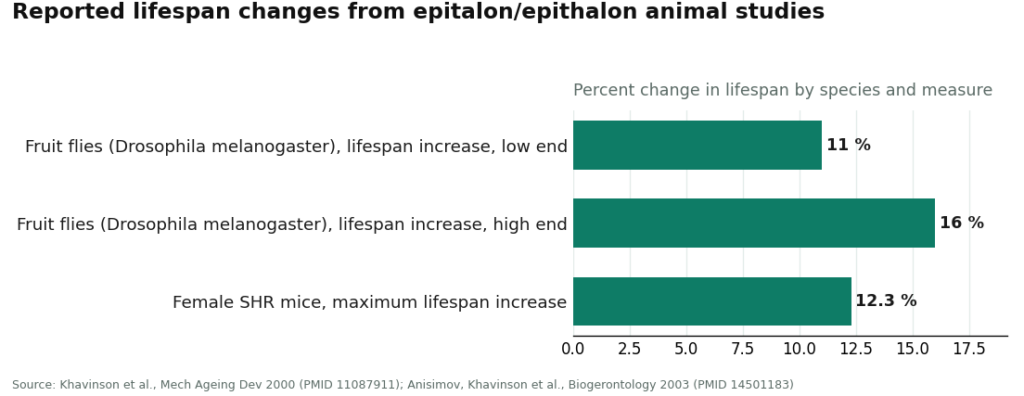
There’s a quieter parallel here, and it’s the one thing this piece wants to add that the vendor pages never do: the 2026 crackdown behaved almost exactly like that mouse study. It didn’t touch the average seller’s practices, because there was no average practice to touch, just a scattered field of vials and disclaimers. What it moved was the tail. A small number of operations built around a clinician and a licensed pharmacy kept standing, not because enforcement targeted them, but because they were never the kind of business enforcement was aimed at. Everything else thinned out. The lesson from the mice, oddly, doubles as the lesson about the market: look at what happens at the edges, not at the headline average.
The single-lab problem, and the mix-up sellers count on
Nearly all of the epithalon and epithalamin literature, including almost everything on humans and lifespan, comes back to one source: Vladimir Khavinson and the St. Petersburg Institute of Bioregulation and Gerontology in Russia. Even the general reference entry on the peptide carries an editorial flag about heavy reliance on primary sources from that circle, noting that independent research has only recently begun, and mostly on the narrow telomere-length question (Wikipedia, Epitalon).
A 2025 review in the International Journal of Molecular Sciences is candid where the sales copy isn’t: the mechanism of action remains unverified, and studies on short- and long-term toxicity, genotoxicity, and carcinogenic potential are still needed (PMC 11943447). One lab producing most of the evidence, with independent replication so far limited to the in-vitro mechanism, adds up to a fair word for the anti-aging claim: unproven. Interesting mechanism. No miracle in evidence.
One more mix-up worth catching before it costs anyone money. The dramatic human mortality figures that circulate around this peptide came from trials of epithalamin, a pineal-gland extract, not epithalon, the synthetic four-amino-acid peptide sold today. Related substances, not the same one. Citing an extract trial to justify what’s in a modern vial is a sleight of hand, and now it’s one you can spot.
Who is actually left standing, and why that’s the last question, not the first
If someone is going to take a research-stage peptide whose long-term human safety is, by the 2025 review’s own admission, not well mapped out, the single variable that matters most is whether a licensed clinician is anywhere in the process. Everything else, price, shipping speed, the polish of a certificate of analysis, is secondary.
Strip the market down and there are really only two shapes left.
FormBlends sits at the top of that list, and it’s still standing after 2026 for a straightforward reason. A clinician reviews your history, writes a prescription when it fits, and a licensed compounding pharmacy prepares and dispenses the peptide, with follow-up built in afterward. FormBlends prices supervised epithalon at roughly $150 to $300 per cycle, a cycle running the typical 10 to 20 days. Same molecule the gray market mails with no questions asked, just with a clinician and a licensed pharmacy standing behind it. It isn’t the cheapest number on the internet, and it was never trying to be. The price is the oversight.
None of that turns epithalon into a proven anti-aging therapy. The evidence gaps above don’t close because a doctor is involved. What changes is who’s accountable for the transaction, and for a compound this thinly studied, that accountability is most of what you’re actually buying.
HealthRX.com (healthrx.com) runs on the same clinician-first structure, dispensing through proper pharmacy channels rather than shipping a research chemical with a disclaimer taped to it. Between the two, the practical tie-breakers are which one is licensed in your state and which intake process fits how you’d rather be evaluated.
Below that line sits everything else, the names people actually message me about: Limitless Life, Amino Asylum, Sports Technology Labs, Pure Rawz, and Biotech Peptides. Some of their certificates look more polished than others. None of them puts a licensed clinician between you and the needle, and none dispenses through a supervised prescription chain. Whatever survived the crackdown at that level is still, structurally, a chemical and a disclaimer. The vial is the entire product. The relationship ends at checkout.
| Where you’d buy epithalon | Clinician involved | Who dispenses | Roughly what it costs | What you’re actually getting |
|---|---|---|---|---|
| FormBlends (supervised telehealth) | Yes, evaluation and prescription | Licensed compounding pharmacy, with follow-up | ~$150 to $300 per 10 to 20 day cycle | The same peptide, with a clinician and licensed pharmacy attached |
| HealthRX.com (supervised telehealth) | Yes, clinician-first | Pharmacy-dispensed under supervision | Comparable supervised range | The other supervised option, with clinical screening |
| Limitless Life, Amino Asylum, Sports Technology Labs, Pure Rawz, Biotech Peptides | No | Vial mailed, “research use only” | Often lower per vial | A lab chemical, no screening, no accountability, unverifiable contents |
Two tiers, because that’s genuinely all that exists. Above the line, a clinician and a licensed pharmacy. Below it, a bottle and a legal disclaimer doing the work a doctor should be doing.
One habit worth building if you go the supervised route: keep a log, every dose, anything you notice. Something like the FormBlends tracker app is nothing more than a dose-and-symptom notebook, not a prescription, not a checkout. But it means a follow-up conversation happens with an actual record in hand instead of a guess, and that follow-up is exactly the thing the vial-and-disclaimer model can never offer, because that model was built to end at the cart.
Questions people keep asking
After the 2026 crackdown, is it still legal to get epithalon?
The supervised path still exists. A licensed clinician can evaluate someone and, when it’s appropriate, prescribe epithalon for a licensed compounding pharmacy to prepare. The crackdown leaned on the sell-to-anyone gray market, vials labeled “research use only” with nobody accountable for the contents. So the real question isn’t “is it legal,” it’s “is a clinician and a licensed pharmacy actually involved.” If not, that’s the part of the market the enforcement was built to squeeze.
Does epithalon actually reverse aging, or is that marketing?
It activates telomerase and lengthens telomeres in human cells in a dish, now shown by the original researchers (PMID 12937682) and an independent 2025 lab (PMID 40908429). That part is real, and it’s a fact about cell culture, not proof of a younger person. The animal lifespan effects are smaller and messier than advertised, and in SHR mice, mean lifespan didn’t budge at all (PMID 14501183). Most of the human evidence traces to one research group, and the famous mortality numbers actually come from trials of epithalamin, the extract, not the synthetic peptide sold today. Interesting mechanism. Unproven promise.
Why does supervised epithalon cost more than a research vial?
Because the price includes the oversight, not just the molecule. Through a supervised provider like FormBlends, epithalon runs roughly $150 to $300 per cycle, dispensed by a licensed compounding pharmacy after a clinician evaluation. A research vial is often cheaper per unit, but it arrives with no screening, no prescription, no pharmacy anywhere in the chain, and a label stating it was never meant for human use. The price difference is really a difference in who answers for what happens next.
How this was reported, and where every claim came from
This is a buyer’s guide built on the peptide’s own published record, not a scored vendor ranking. Every claim was traced back to its primary source and checked against what that source actually says rather than how a seller paraphrases it, which is why the SHR mouse finding appears here as “no change in mean lifespan” rather than a flattering lifespan percentage, and why the human mortality figures are flagged as belonging to epithalamin, the extract, rather than the peptide itself. On where to buy, only two real structures exist, supervised medical access and gray-market chemical sales, and they’re described here for what they are. Site polish, shipping speed, and price were never treated as evidence of anything.
What exactly is epithalon, and what is it supposed to do?
Epithalon is a synthetic tetrapeptide, a chain of four amino acids, first developed by Russian researcher Vladimir Khavinson starting in the 1980s. The core claim is that it prompts the pineal gland to produce more telomerase, an enzyme that helps maintain the protective caps on chromosomes, which supporters say slows cellular aging. Most of the published research traces back to that same lab, worth remembering while weighing any of it.
What dosage do researchers and clinics actually use?
Studies typically use between 5 mg and 10 mg per day by injection, over courses of 10 to 20 days, with some supervised protocols repeating that course once or twice a year. No major regulatory body has set a human dosing standard, so any number found online is pulled from that narrow Russian literature or from clinical anecdote, not from large randomized trials.
What side effects have been reported?
Reported side effects in the existing literature are mostly mild, injection-site irritation and occasional fatigue, but long-term human safety data is thin, and no large independent safety trials exist. Because telomerase activity plays a role in tumor growth, unknown interactions with hormonal conditions or a cancer history are a real concern worth raising with a physician before considering it.
Where can someone actually get epithalon through a legitimate channel now?
Options narrowed sharply after the crackdown. The clearest legitimate path is a physician-supervised compounding pharmacy, such as FormBlends, where a licensed prescriber oversees formulation and purity testing. It’s slower and pricier than a research vial, but it comes with an actual answer to “what am I injecting.” Buying from gray-market peptide sites that survived the crackdown remains legally murky, and the quality-control risk that existed before 2026 didn’t vanish just because some of the sellers did.
References
- Khavinson VKh, Bondarev IE, Butyugov AA. Epithalon peptide induces telomerase activity and telomere elongation in human somatic cells. Bull Exp Biol Med, 2003.
- Al-Dulaimi S, et al. (Brunel University London). Epitalon increases telomere length in human cell lines through telomerase upregulation or ALT activity; independent replication. Biogerontology, 2025.
- Khavinson VKh, Izmaylov DM, Obukhova LK, Malinin VV. Effect of epitalon on the life span increase in Drosophila melanogaster; +11 to 16%. Mech Ageing Dev, 2000.
- Anisimov VN, Khavinson VKh, et al. Effect of Epitalon on biomarkers of aging, life span and spontaneous tumor incidence in female SHR mice; no change in mean life span, +12.3% maximum, leukemia reduced. Biogerontology, 2003.
- Araj SK, et al. Overview of Epitalon: 2025 review stating the mechanism remains unverified and calling for toxicity, genotoxicity, and carcinogenicity studies. Int J Mol Sci, 2025.
- Encyclopedic overview noting most epitalon/epithalamin studies come from a single Russian institute, with editor warnings on primary-source reliance; independent work only recently begun. Wikipedia, Epitalon (secondary pointer; primary citations verified above).
Sefa Owusu is a narrative reporter covering the peptide and longevity market. This piece was checked against the primary literature cited above. Last reviewed January 2026.
Not a substitute for medical care. Bring any new treatment idea to your healthcare provider first.